Showing posts with label Impressionism. Show all posts

Tuesday, October 22, 2013

Stories in painting III: like a dog

Paul Cezanne. Compotier, Glass and Apples. 46 x 55 cm. Oil on canvas. 1880.  
This still life by Paul Cezanne returns us to the tale of disappearances of stories from paintings (here are two first posts from this little series: 1, 2). Another episode of this particular plot in the history of painting: its conscious divorce from "literature" in the age of impressionism. 

Rainer Maria Rilke recounts an interesting dialogue in his "Letters on Cezanne" (letter of October 12, 1907). He asked a painter friend of his, Mathilde Vollmoeller, to go with him to Cezanne's exhibition; and at one point, she told him: "He sat there in front of it like a dog, just looking, without any nervousness, without any ulterior motive." 

A remarkable turn of phrase, "like a dog", isn't it? I believe it means, first and foremost, "story-less": a quieted mind, without endless "stream of consciousness" which tends to keep talking in our heads, weaving endless stories about itself and the world, and creating nervousness and ulterior motives in the process.  

As far as I recall, Noam Chomsky estimates that this ceaseless silent talking constitutes 95% of our linguistic activity; in other words, 95% of talking goes on in our heads without ever being "externalized". Which means, for him, that that is the function of language: thinking, not communication. Yet there is also a theory (or rather, a cluster of theories from different fields) that real thinking happens non-verbally; that this eternal internal story-telling, while not without some usefulness, takes over too much of our inner life and distracts us from awareness of here and now; from being fully alive and present in the moment: like a dog.  

There is also this hypothesis (present in somewhat different forms in different theories) that this inner storyteller's role (however one calls it) in our lives has been increasing throughout history and is actually getting out of hand, occasionally becoming more harmful than it is useful. Insofar as this is true (as I believe it might be), this evolution could just be what the age of Impressionism was responding to -- in moving painting away from stories and towards here and now.    

It might also be the reason why impressionism remains relevant, and meaningful, and so alluring for painters and viewers. I will return to this theme tomorrow, please stay tuned... 

Thursday, July 4, 2013

Cezanne's composition: the first look at how it works

Paul Cezanne. Mont Sainte-Victoire. 65 x 81 cm. c. 1890.
Paul Cezanne is often called "the father of modern painting", and that's true in so many senses that it almost becomes false: it's a father who would probably never acknowledge most of his "children". What I mean is that (I believe) Cezanne achieved a new kind of synthesis between different aspects and elements of painting, and his various "descendants" took this fragile whole apart, running away with one or another part of it (and often making it into an all too easy "recipe" for painting-making). So, for example, Cubism (especially the analytical cubism) evidently descends from Cezanne's achievements, but it's very much debatable whether Cezanne himself would have accepted its flat planes without colour modulations as a painting (as we know, he intensely disliked even Gauguin's flat shapes). 

What I want to do is go back to the original synthesis, to try and understand how this all works together in composing a painting. As of now, I am planning a two-months series of (weekly) posts on Cezanne's composition (to be completed before my two-weeks vacation in September), but it may be continued later.    


Monday, May 13, 2013

Sonnet 37: Made lame by Fortune's dearest spite

Lena Levin. Sonnet 37: Made lame by fortune's dearest spite. 20"x20". Oil on linen. 2013.

William Shakespeare. Sonnet 37


As a decrepit father takes delight
To see his active child do deeds of youth,
So I, made lame by fortune's dearest spite,
Take all my comfort of thy worth and truth. 
For whether beauty, birth, or wealth, or wit,
Or any of these all, or all, or more,
Entitled in thy parts do crowned sit,
I make my love engrafted to this store: 
So then I am not lame, poor, nor despised,
Whilst that this shadow doth such substance give
That I in thy abundance am sufficed
And by a part of all thy glory live. 
Look, what is best, that best I wish in thee:
This wish I have; then ten times happy me! 

Nonso Anozie reading this sonnet


In the drama of the sonnets sequence, this poem sounds like an attempt to distance oneself from the trappings of romantic infatuation and return to a calmer, more altruistic, nearly paternal love of the early sonnets; but now unconditional, without any requests or indictments: Whatever my own state and whatever you think of me (if anything at all), I am really ten times happy, insofar as you are happy. 

Tuesday, January 22, 2013

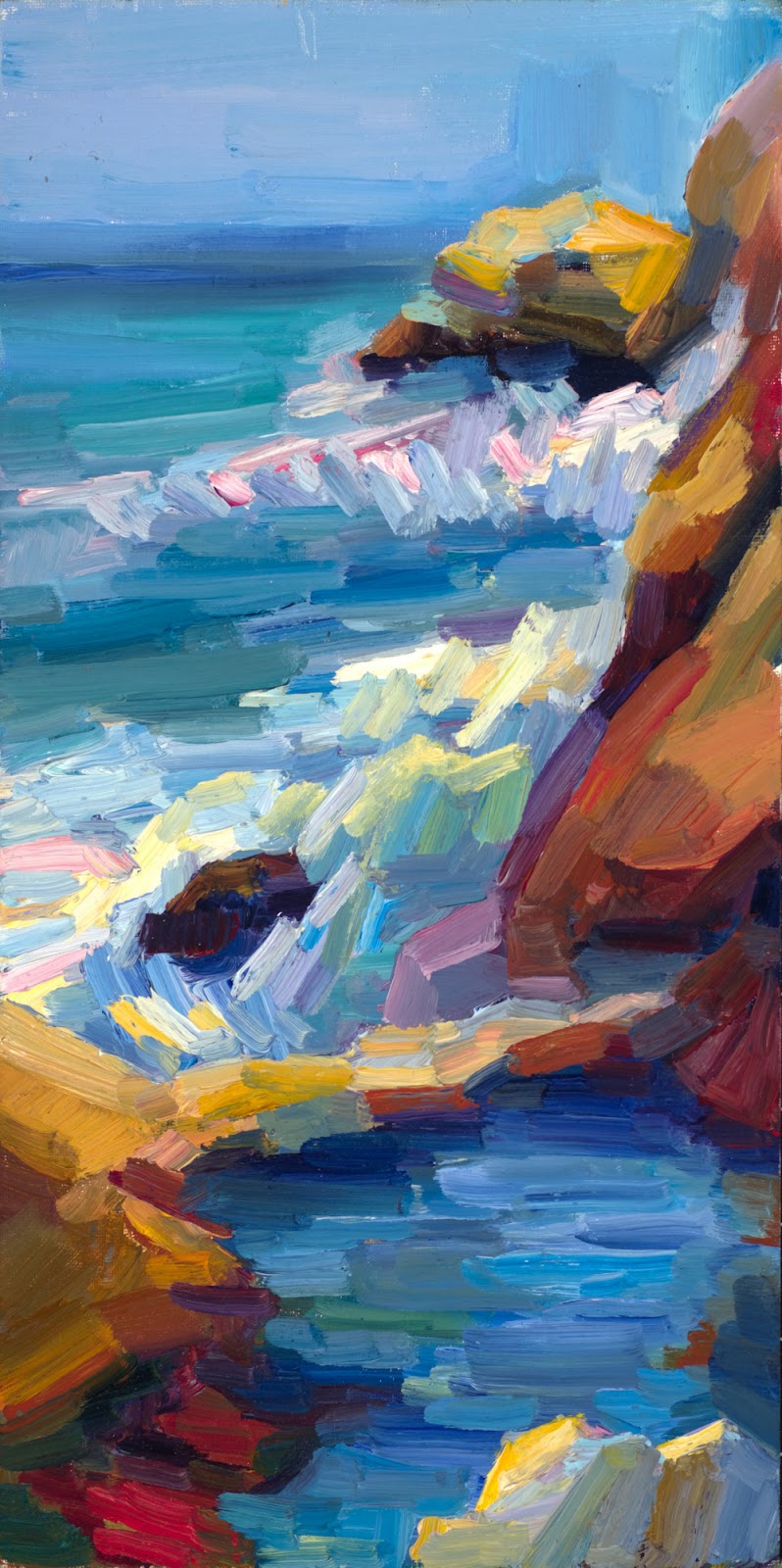
Pacific impressionism

Pacifica. 16"x8". Oil on canvas panel. 2010
I have two other bits of essential writing to complete, so I've missed the yesterday's post on this blog, and I am only here today to tell you that this piece of unabashed, direct, straightforward impressionism, which has been a favorite with many of my G+ friends, and has spent the last year on my own wall, is now released on Daily Paintworks, so you can bid here. 

This was done fully en plein air, without a single bit of studio rework. It was so windy that I hid myself and my easel within a little cleft in the rocks, which opened for me this unusual vertical view of the Pacific Ocean.  

Saturday, January 5, 2013

Realism and impressionism

Bread and water. 12"x12". Oil on canvas panel. December 2011
I want to continue the discussion of "realism" with a look at the distinction between "realism" and "impressionism", using this work, newly listed on Daily Paint Works today, as an illustration. I will probably return to this issue later though, with more historically, and art-historically, appropriate illustrations, when I am back from my week-long trip to Chicago and New York. 

It seems to me that "realism", as a word, has an intrinsically positive ring to it: in the semantic networks in our minds, it links itself to reality, truth, honesty; even depth. It doesn't necessarily mean that these positive connotations are fully inherited by the art-historical term, not for everyone and not as it is commonly used now; but they are still there, in the word itself. "Impressionism", on the other hand, was originally coined as a strongly negative term, implying more superficiality, lack of thought and depth, rather than truthfulness of immediate and genuine visual impressions suggested by Claude Monet's use of the word. As it so often happens, it has acquired its positive ring over decades of sustained success with public; but this didn't save the original content and pitch of impressionistic enterprise, which has been reduced to a limited range of technical effects (like split color)  and, occasionally, even to some sort of colorful prettifying of reality, or to an acceptable excuse for the lack of draughtsmanship.     

But it isn't what it was all about, was it? The original impressionist breakthrough in color was inseparable from their drive to paint what was really there, what they saw around them; the real life, not its barren reduction to classical academic ideals. Just as the real people aren't ever Apollos and Aphrodites, the real towns aren't holiday postcards, and real still life "set-ups" aren't filled with silver goblets -- so skies aren't ever pure blue, nor grass ever pure green, nor flesh tones warm and even.       


Monday, October 1, 2012

Hidden meanings

Yellow Roses. 16"x12". Oil on linen panel. 2012
I have been thinking lately about this core conundrum of human existence: arguably most essential things in life – things happening within us, in our inner selves – are nearly impossible to name meaningfully. We do have names for them, to be sure, but we can never be absolutely sure what these names mean to the next person. 

As children, we hear the words, do our best to infer their meaning from how they are used, and then to attach them to our own emotional and spiritual experiences (or sometimes we are told to wait – till we grow up and have the necessary experience to attach the name to). We seem to implicitly rely on the assumption that everyone has access to a universal inventory of emotions and experiences, more or less exactly corresponding to the lexicon available in whatever language happens to be our native one. But take my word for it (if you don't happen to know this yourself) – these parts of lexicons vary enormously from one language to another; and some languages manage almost without it at all (as a matter of fact, I used to study a language with a lexicon of about two thousand words in total, most of it, quite naturally, dedicated to "useful", concrete things and actions). 

Being born into a language rich in names for intangible phenomena, each with its own heritage of religious, poetic, cultural contexts, inevitably places you into a mysterious forest of (names of) other people's experiences and emotions, in which you try and find your own, in your own idiosyncratic way; and then "coordinate" your system of names with everyone else's, in search of some semblance of mutual understanding, so that you don't feel quite alone here. 

Maybe that's the most obvious "function" of arts – to break, or at least make some holes in – the walls of the solitary cells that are our skulls, the walls which sometimes seem to be even more impenetrable by everyday words. And yet, this opens a whole new can of worms: the way artists (and everyone else who cares to participate) talk about art, its meaning, the process, its higher purpose, its principles, even its definition. Reading, and listening, I often feel that almost any alignment between words and meanings has been lost irrevocably in this semantic domain: people use the same idioms to refer to quite different things, and different names for essentially the same thing; and quite often, words are being just thrown around like tennis balls, devoid of any connection to meaning – and those who have direct access to meanings, don't find adequate words. And yet, sometimes something miraculous seems to happen, and we seem to understand one another, if only for a brief moment – and so we try more, in hope to encounter this miracle again. 

A bowl of apples against rowan-berries. 12"x12". Oil on canvas panel
As a matter of fact, this was the original goal of this blog post: I wanted to approach the question of relationship between the process of painting and the emergent meaning (in the most general terms) by contrasting two of my own paintings which might seem similar in their "genre" and their lack of of any direct and obvious "message", but are nearly opposite in terms of how they came to be and how their hidden meaning emerged (from my point of view, at least). But I seem to have spent the "real estate" of this post on introductory remarks, so that I'll probably have to make it into a series, "Process and Meaning", to be continued next week. 

If you have read till this point, you might probably be interested in the fact that both of these works are currently auctioning at Daily PaintWorks (so you can have a direct access to whatever meanings are hidden in them for rather low prices... ). As for me, I have a week more to gather my thoughts on the relationship between the process and the meaning.


If you want to be notified of new works offered for sale on Daily Paintworks without following me on DailyPaintWorks.com, there are three options:

  • I will mention newly listed paintings here, in my weekly post on Mondays – so if you follow this blog, you will receive this information weekly.
  • If you are on Google+, you can leave me a comment on any post there, and I will add you to the circle where I give the links to auctions as I list the paintings (I don't send out notifications, just make these announcements visible only to those who expressed their interest). 
  • If you are on Twitter, I also try to share all these links there (@LenaLevin_paint). 


Monday, September 10, 2012

Studies and impressions

Apples on white cloth. 16"x12". Oil on linen panel. 2011
I have two pieces of studio news to share today.

  • First, my website now offers high-resolution images under Creative Commons Attribution Non-Commercial license – just click on any image in any gallery to see it better and, if you wish, download for your own non-commercial enjoyment.
  • Secondly, I have begun offering a subset of my works, which I call "Studies from life", or "Impressions" on DailyPaintWorks.com. This blog now has a gadget showing the contents of my gallery there (above is one of the works currently auctioning).
What is it, exactly, that will be, offered via Daily Paintworks, and how does this body of work differ from the rest of my paintings? 

First of all, they are, of course, done from life, without conscious intervention from memory or imagination: it is just a still-life set-up or a view en plein air, a particular moment in time with its particular light and mood, and me with my canvases and brushes submerged in this moment, and in what I see before me, as deeply as I can. In contrast to this, most of my other works, even if done from life, involve a conscious intent beyond this pure seeing and painting. 

This might not be always obvious to a viewer, since neither of these studies are realistic in the usual sense of the world; but for me, inside this process, I truthfully paint what I see. What intervenes between the "reality" and the resulting work is but my own sense of vision and my emotional state at the moment. And since this process itself almost invariably fills me with joy of life, this turns out to be the core message of these works, whatever their specific subject matter. In a sense, this body of work is as close as I get to the original essence of Impressionism (hence "Impressions" as the alternative name).

This practice is an essential, core part not only of my studio practice per say, but also of my life as a whole: as necessary for being alive as sleep, bread, water, walks, books. I want to share them with you for as low a price as seems remotely reasonable – because I don't want them to be a "luxury item"; they won't be comfortable in this role at all. 

As of now, I am trying to do this with the help of DPW auctions with very low initial prices, and with a bit higher "buy now" price offered in each auction's description (since the "Buy now" option is not formally supported on DPW, you would need to contact me for that, so I could take the work off the auction). I'll see how it goes in the future, and maybe make some adjustments to the process.

If you want to be notified of these auctions without following me on DailyPaintWorks.com, there are three options:


  • I will mention newly listed paintings here, in my weekly post on Mondays – so if you follow this blog, you will receive this information weekly.
  • If you are on Google+, you can leave me a comment on any post there, and I will add you to the circle where I give the links to auctions as I list the paintings (I don't send out notifications, just make these announcements visible only to those who expressed their interest). 
  • If you are on Twitter, I also try to share all these links there (@LenaLevin_paint). 

And that's basically it, till next Monday!