Showing posts with label plein air. Show all posts

Thursday, May 2, 2013

Home unaware that it's home

Home unaware that it's home, after Marina Tsvetaeva. 12"×24" (30.5×61cm). Oil on canvas. December 2012. 
Joseph Brodsky once said that writing poems is addictive because it involves a different thinking process, an increased speed of thinking; the language you are serving helps you along, and you arrive at thoughts you would never have come across in any other way. Or that's how I remember it anyway... 

The process of painting this painting wasn't swift by any stretch of imagination, but it did, ultimately, help me realize a very fundamental thing, which I might not have understood otherwise; about myself, and the world, and my place in this world. Or rather: about the non-existence of such a place in the conventional, material sense of the world. 

See, ever since I've started representing myself as a painter, I kept experiencing a momentary, fleeting discomfort whenever I had to name the place where I am located, or "based", as the usual phrase in artists' introductions happens to go. It is, indeed, conventional, to start such introductions with the name of a place. And I understood all along how it might be relevant: after all, paintings should be viewed "in real life", right? And that's easier if the painter's studio is close to where you are. And I wrote an honest, plain truth about where I am; so, wherefore the discomfort, this momentary pain of misalignment between what I am saying and what I am feeling? 

Although I've never given this feeling a second thought (or so I imagined), this question, or rather its somewhat deeper version is the one that got gradually answered in this particular process of painting, which had spanned more than three years.  

An old barn. 8"×16", Oil on canvas panel, July 2009

The long road to this painting had three visible, documented steps. The first one (sold long ago) was done en plein air, in the nearby Picchetti winery; here it is, on the left. What attracted me to the scene in the first place was a pure visual enjoyment in the natural rhythm of long, swift diagonals, which connected together the areas of light and shadow on the ground, the roof of the barn, and the upper edge of the trees. 


An old barn. 12"x24". Oil on canvas, August 2009 
But the initial plein air study was inevitably richer in real-life details and color variations: in the studio work on a somewhat larger canvas, I've made an attempt to simplify the scene and strengthen its major rhythms. This attempt, successful to some extent in its own terms, left the painting in the state of emptiness: the material richness of real-life impression was gone, as though in a memory, but a memory devoid of any emotional meaning, almost a pure exercise in geometry.

The idea for the latest rework came more than three years later, one early December morning, while we were driving through the town of Fremont where we now happen to live. The December light in this area can be quite magical, almost otherworldly – especially contrasted with its very pragmatic, and often downright ugly, architecture. The strangeness of it, the fleeting of awareness of somewhat surrealistic randomness of this moment in time and place, overwhelmed me: what is it that we are actually doing, on the eve of 2013, in Fremont of all places, as though that's where and when we are supposed to be; as though that's where we belong. It's not our time, it's not our place, and yet here we are, rather cozy, on a random domestic errand.

There is a poem to go with this particular feeling, the feeling of an uprooted human being, who, most of the time, finds this state of rootlessness quite fitting, in harmony of their inner state of mind; the feeling of momentary disruption of this harmony, the hint of a vanished, unrealized life. A poem by probably the most tragic Russian poet, Marina Tsvetaeva, who had spent much of her adult life in emigration (and then came back to Russia, to an even more tragic experience, and, ultimately, a suicide). The poem defies translation, I believe, but the title of this painting contains a slightly hidden reference to it. And this is what this painting is now about, with its contrast between the original pastoral scene and the way it's being seen.


That's how many of my paintings come to be: a visual impression pulls out of my mind a memory of a poem, or a poem triggers a memory of my own visual impression, innocently stored in the brain or even painted en plein air at some point; this creates a spark of energy which transforms into a painting. But this one has given me something more than this: I understood not only why I am feeling this discomfort while naming Fremont as my location, but also why I am here.  

You see, there is an expiration date on things in our life that we can  honestly attribute to randomness, or childhood influences, or any other external circumstances. There comes a time when one can safely assume that everything in their life is, in one way or another, chosen or even "made" by oneself: neither good luck nor bad fortune, just one's very own self. Although the reasons for our living in Fremont were disguised by a thin veil of "circumstances" which had lead us here (although there is a variety of places in this world that we would have preferred), it was we, ourselves, who had brought us here, however random and strange this place might seem.   

It's not the first time in this post that I use the word "random", and that's not an accident. Because the very randomness of this place, its arbitrariness, its lack of pull on my imagination, which might have tempted me to feel "rooted" here: these are the very reasons I am here. It might have been another, equally random, town; it doesn't really matter. If the place where I live did matter, it would be another place entirely. A grand metropolis with a thriving cultural life; a beautiful beach or a mountain range; a medieval town soaked in rich layers of history: all these might have tempted me to feel rooted again, to become attached to a place, to feel as though it were home, my place in the universe and, in the end, to distract me from my genuinely real life, which happens inside my head and within my studio. 

As it is, I am both here and nowhere; I am a passerby with a studio, still, as ever, a rootless cosmopolitan, in love with many places, but not really with either. My place in the universe is not geographical at all, it's defined in other dimensions.      

Tuesday, January 22, 2013

Pacific impressionism

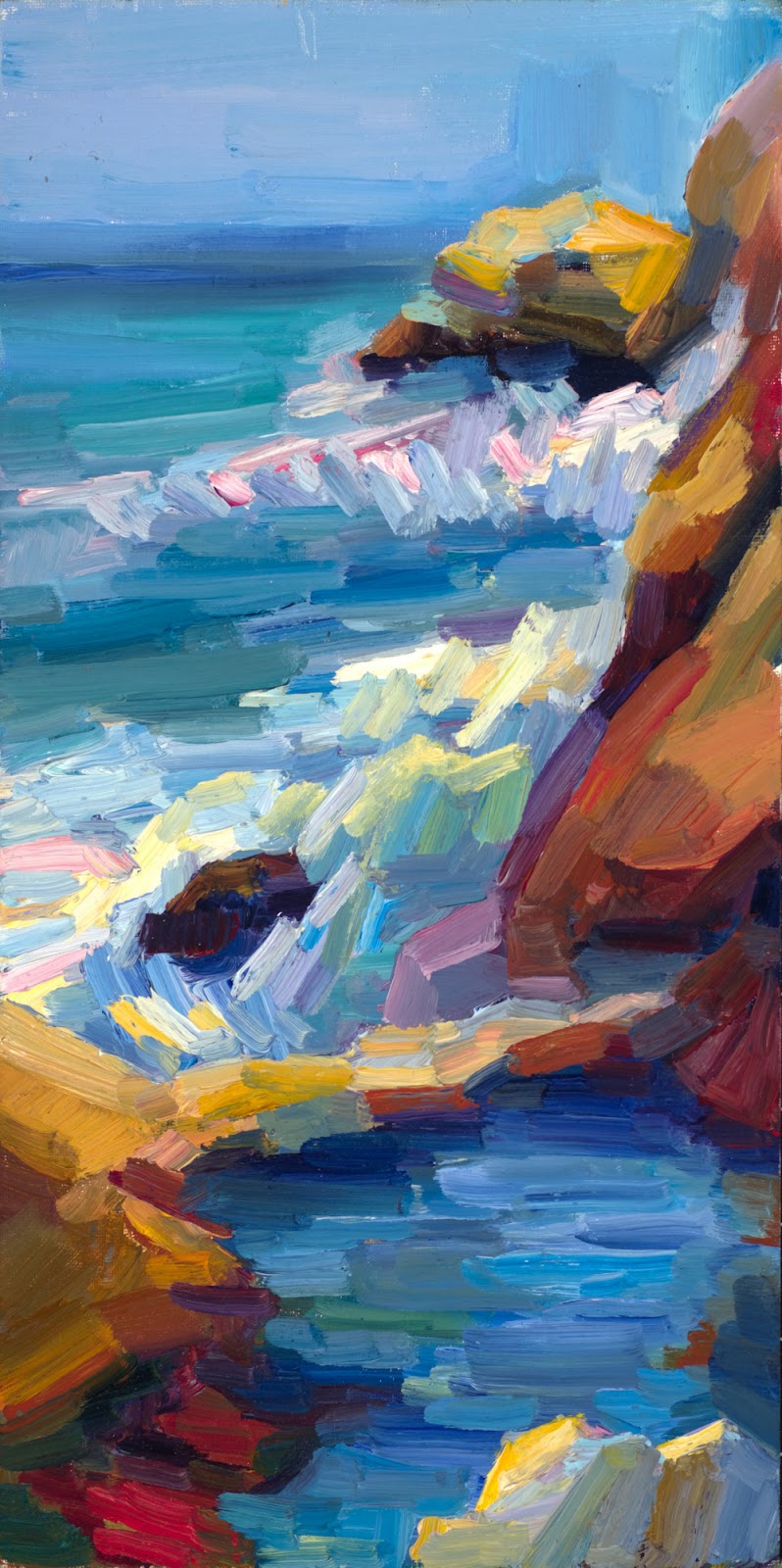
Pacifica. 16"x8". Oil on canvas panel. 2010
I have two other bits of essential writing to complete, so I've missed the yesterday's post on this blog, and I am only here today to tell you that this piece of unabashed, direct, straightforward impressionism, which has been a favorite with many of my G+ friends, and has spent the last year on my own wall, is now released on Daily Paintworks, so you can bid here. 

This was done fully en plein air, without a single bit of studio rework. It was so windy that I hid myself and my easel within a little cleft in the rocks, which opened for me this unusual vertical view of the Pacific Ocean.  

Monday, December 10, 2012

Plein air and beyond

Howard Creek Ranch Plein Air. 16"x12".
Oil on linen panel. July 2012
Many a book about plein air painting, and many a teacher, will tell you that you have to figure out, for yourself, what attracts you in the view you have chosen, what is interesting about it, before you start painting, or even before making preliminary compositional sketches. I agree that it is generally a good idea; all in all, it's better to think before doing something, on most occasions. For me, though, it doesn't always work like this; often, I have to work on a painting, both en plein air and afterwards in the studio, before I even begin to understand what this painting is all about. 

This post begins with a plein air study done while we were staying at Howard Creek Ranch: the hills behind the farm house, with a forest running down to its rose garden, with the ocean behind the viewer. What I thought attracted me to this view were two technical challenges: compositional, with the hill dominating both the sky above and the garden and the roof below; and coloristic, with dominant greens and their subtle variety (by the way, no green pigments have been used in the making of this painting). 

The native hue of resolution. 24"×18"Oil on linen, August 2012
Back in the studio, though, this motive began unravelling in two slightly different directions. The first one took place on another, larger canvas: the original peaceful, inert greens splitting into contrasting blues and yellows. The eternal fight between three primary hues replaced the green-dominated color harmony, only slightly punctuated by reds. It's the same landscape, but with its latent energy unleashed in outburst of primary colors. The same landscape, but viewed by another person (inasmuch as one human being can be different persons at different times and places and contexts).

I remember a garden. 16"x12".
Oil on linen panel. September 2012
The second reinterpretation of the original motive took place on the same panel, as a studio re-work of the plein air study. It is now called "I remember a garden", a slightly hidden quote from "The English Patient". If you recall, the man who says this has never actually seen the garden he remembers; he only heard about it in a moment of extreme heightening of emotions: a peaceful garden, running down to the sea, the garden of his beloved's childhood home recalled in a time of pain and mortal danger. 

So this was, as it turned out, what attracted me to this view in the first place: the initially unrecognized hint of shared remembrances of things past, the ever-present contrast between peaceful harmony of nature and painful energies of human emotions attached to it. 

Thursday, September 20, 2012

Just one day

Tine is a skin, not a dress. 11"x14" (27.9x35.6 cm). Oil on linen panel.
Today has been a good day in the studio, although it didn't promise to be so, and I want to record as it has been happening – because if ever I received a confirmation of the often quoted promise by Picasso –  that inspiration does come, but must find you working, today is the day. I cannot even tell, at the moment, if anything I've done today is any good – and yet the impressions of the day have been so powerful, so real, so intense, so rich – that it doesn't really matter that much. 

I woke up after a long night's sleep, but not feeling refreshed; rather, still exhausted from yesterday's work on the 27th sonnet painting and from reviewing a whole bunch of recent work – which resulted in a dozen paintings landing back in my "in-progress" pile. Without much hope for a fruitful day, I decided to try and work on some of these; and not the most important to me, either. Not because I expected the inspiration to come, but just because I need to paint. I decided I wouldn't even confine myself to focusing on a single painting, but would just switch between them whenever I like; just to keep it going, rather than to achieve anything in particular. The onions panel above was the first one, and I stopped rather quickly, with the painting suspended in an intermediate moment from which I had no idea where to go. 

Be Italian. 11"x14" (27.9x35.6 cm). Oil on linen panel.
As I switched to the next still life, this one on the left, filled with bread, onions and tomatoes, it began to play in my head the song "Be Italian", from the musical "Nine". The association, albeit purely gastronomical at its conception, soon started playing back into the painting, endowing it with richer and more passionate reds and fierier rhythms. Here is the song, in case you don't remember it:


Howard Creek Ranch plein air. 16"x12".
I stopped working on this still life at an earlier stage, not reflected in the photo (to return to it later in the day), because the intensity which comes from interaction between two (here, rather three) art forms inspired me to switch to a panel more important to me, which has been sitting in the "in-progress" pile for some time. I felt something important hidden in it, but it wouldn't reveal itself; and I didn't know how to approach it. Here on the left is the original plein air study I brought from our stay at Howard Creek Ranch in July. It had been tweaked a bit in the meantime, but without any clear sense of direction or meaning. The subject matter and the overall rhythms of the painting seemed to resonate with something within my memory and mind; but the link was vague and too weak to work from. 


I remember a garden. 16"x12" (40.6x30.5 cm). Oil on linen panel.
This is the photo of the same panel by the end of today's painting session. Its working title now is "I remember a garden" – a slightly hidden quote from "The English Patient" (I remember a garden, running down to the sea). Said by a man who doesn't want to remember his life, but remembers a garden he has never even seen, but was just told about by his lover, in a more intense and joyful moment of his life. So it is not a painting about a garden; it's a painting about shared memories and impressions, and their overwhelming intensity. 

Because my studio session today was filled with memories and impressions of sunny Italian beaches and cool English gardens, with a little boy's early passions and later struggles, with love and pain of a Hungarian count, and with the farewell letter of a woman dying in an African desert. And I am richer and more alive after the studio time than I was in the morning, slow and sleepy as it was. This is, in the end, what art is all about.   

Monday, September 10, 2012

Studies and impressions

Apples on white cloth. 16"x12". Oil on linen panel. 2011
I have two pieces of studio news to share today.

  • First, my website now offers high-resolution images under Creative Commons Attribution Non-Commercial license – just click on any image in any gallery to see it better and, if you wish, download for your own non-commercial enjoyment.
  • Secondly, I have begun offering a subset of my works, which I call "Studies from life", or "Impressions" on DailyPaintWorks.com. This blog now has a gadget showing the contents of my gallery there (above is one of the works currently auctioning).
What is it, exactly, that will be, offered via Daily Paintworks, and how does this body of work differ from the rest of my paintings? 

First of all, they are, of course, done from life, without conscious intervention from memory or imagination: it is just a still-life set-up or a view en plein air, a particular moment in time with its particular light and mood, and me with my canvases and brushes submerged in this moment, and in what I see before me, as deeply as I can. In contrast to this, most of my other works, even if done from life, involve a conscious intent beyond this pure seeing and painting. 

This might not be always obvious to a viewer, since neither of these studies are realistic in the usual sense of the world; but for me, inside this process, I truthfully paint what I see. What intervenes between the "reality" and the resulting work is but my own sense of vision and my emotional state at the moment. And since this process itself almost invariably fills me with joy of life, this turns out to be the core message of these works, whatever their specific subject matter. In a sense, this body of work is as close as I get to the original essence of Impressionism (hence "Impressions" as the alternative name).

This practice is an essential, core part not only of my studio practice per say, but also of my life as a whole: as necessary for being alive as sleep, bread, water, walks, books. I want to share them with you for as low a price as seems remotely reasonable – because I don't want them to be a "luxury item"; they won't be comfortable in this role at all. 

As of now, I am trying to do this with the help of DPW auctions with very low initial prices, and with a bit higher "buy now" price offered in each auction's description (since the "Buy now" option is not formally supported on DPW, you would need to contact me for that, so I could take the work off the auction). I'll see how it goes in the future, and maybe make some adjustments to the process.

If you want to be notified of these auctions without following me on DailyPaintWorks.com, there are three options:


  • I will mention newly listed paintings here, in my weekly post on Mondays – so if you follow this blog, you will receive this information weekly.
  • If you are on Google+, you can leave me a comment on any post there, and I will add you to the circle where I give the links to auctions as I list the paintings (I don't send out notifications, just make these announcements visible only to those who expressed their interest). 
  • If you are on Twitter, I also try to share all these links there (@LenaLevin_paint). 

And that's basically it, till next Monday!

Monday, August 27, 2012

Howard Creek Ranch: a perfect week

Mendocino sunrise. 11"×14", Oil on linen panel


It's been nearly a month since we returned from our impromptu week-long getaway at Howard Creek Ranch Inn on the Mendocino Coast, and I finally have good photos of what I did there (some of the works retouched later). So, it's about time that I told you about this extraordinarily beautiful and friendly place and our charmed week there (please click on any image to see a larger version).

The painting above is a quick plein air study of the Pacific Ocean, done early on our very first morning there, from a little wooden platform above the beach. Since the sun was rising behind me, the sky in the west, above the ocean, is still dark, but the first beams already reach the sand and the foam of the waves rolling towards the beach. I find that overall rhythms of paintings done near the ocean is very much defined by the rhythmic sounds of the waves, as they come towards you and then gracefully roll back. My breath and my arm movements align themselves with this rhythm, and this determines the overall pattern of brushstrokes. 

Highway 1 across Howard Creek. 16"x12". Oil on linen panel.
This spot, with a wide view of the coast and the ocean, is about three minutes walk away from the farm – so we returned to it every day and never grew tired of it. On the left is what you see if you turn away from the ocean and  towards Howard Creek Ranch on the midday of a sunny day of late July: Highway 1 crosses Howard Creek here, but one can walk under the bridge towards the farm: down to the buildings on the left, behind the trees, or up the hill for a walk in the forest.


At this spot, and on this day, everything seems to have both rhyme and reason: the curves of the green trees follow the grander curve of the rolling hill, and the bridge bearing gracefully repeats the shapes of tree trunks. Even though the day was really sunny and clear, the color of the sky changed repeatedly as I was painting, turning from deep blue to blinding yellow-whites, with occasional hints of greyish-purple fog, and back to the depths of the blue. Since my overarching memory of this day is its burning sunniness, I've strengthened and connected the yellows and reds later in the studio, bringing back the day's bright harmony with the large circle of hot colors.

Carriage House. 20"×16", Oil on linen panel

This is a view of the room we stayed in, called "Walden", in the old carriage house, overshadowed by tall trees under high skies. 

If it looks somewhat shabby in the painting, it's because it is – on the outside. You don't get the impression of staying in a modern bed-and-breakfast; it's almost as though you are really staying at a ranch. Inside, though, everything is beautifully handcrafted, with overwhelming attention to every minute detail – a genuine style and the high art of woodwork you would be unlikely to find in the priciest hotels. To add to this charming duality of overall impression, upstairs there is a large living room, complete with a diverse library and a jacuzzi, contrasting with a garage (containing a very old and merrily green tractor) combined with Sunny Grigg's (the owner's) workshop downstairs.

Beach Cabin. 20"×16", Oil on linen panel

Here is a view of another little building, called "Beach Cabin". This study remains as I've brought it home from the trip, untouched in the studio – and I am still not quite sure whether it is complete or not. 

Here, one of the most charming features of the place comes across even more directly than in the previous one: the tall trees raising to the sky high above the buildings, seeming, from the lawn, even higher than the hills behind them. With the Pacific Ocean quietly rolling its waves on the other side, this gives one this ever-present feel of seclusion, distance from the outside world with its hectic noise, the impression of a charmed place filled with peaceful magic. 

Mendocino Sunset. 16"×12", Oil on linen panel.
The last work I want to show you today is a study of sunset, from the same spot as the first study of sunrise. 
 
The first sunset we saw there was absolutely stunning – even Eugene, who generally doesn't appreciate southern sunsets (when the sun doesn't color the whole sky in all shades from orange to violet, but just drops itself behind the horizon, like an egg yolk onto a frying pan), was amazed. But it was too late to run for the easel, so we've decided to come back next day to the same spot.

But here is the thing about planning to catch a sunset – you are totally dependent on weather, and the next three days were more foggy and cloudy, so the sun remained nearly invisible. Finally, two days before the end of our vacation, the sky cleared (or almost cleared), so I've decided to try. But it was nothing like the first day – the sky was colored in very subtle shades, which were changing every half a minute, but the sun remained invisible. That's when I started the painting above.

The next day, it was sunny at last – so sunny that the sun burned my arms and hands during our morning walk (and I don't even want to talk about my face...). In the evening, I was nowhere near a state in which I could seriously paint, and – isn't it always so? – the sunset was brilliant again. I was standing there, on this same spot, trying to capture it in my memory, while Eugene was merrily clicking away with his camera.

And so, this work is not only the end of the day, and the end of our charmed vacation, but also a memory: a later studio attempt to unload whatever of the two brilliant sunsets, the first one and the last one, I did manage to commit to my memory...

If I have overused the word "charmed" in this post, that's because it is really the overall impression of this place, and of our week there, that I've brought home with me, that I tried to capture in these paintings, and that, I hope, will remain with me as long as possible.

Friday, July 20, 2012

Plein Air Vacation!

Anchor Bay (a study from Whale Watch inn)

12"×16", Oil on linen panel, July 2011
The blog goes on a plein air vacation.

The next post will appear on July 30, 2012.

This is a study from the last year's journey to a nearby place, as a preview of a bunch of plein air paintings I hope to bring home with me.

Monday, June 18, 2012

Picchetti winery and Arles

Picchetti winery with Gauguin's red-leafed tree
16"×20", Oil on canvas panel, 2008-2011
This is a story of a time-space tunnel that I seem to have discovered at
Picchetti winery in Cupertino; it leads to Arles of 1888.

This landscape started in December 2008 as a plein air study at Picchetti winery.

Some landscape studies fully resolve themselves right there en plein air; you bring them home, look at them some time later, and they seem to retain all the freshness and strength of the experience. It's always a joy to see it,  but it doesn't
happen all the time, and it didn't happen with this one. It looked bleak, chalky, its color weak and nearly dead, not even close to what I had seen and hoped to convey: you can see it for yourself on the earlier photo of the same panel to the left.

I haven't discarded it right away, though, because there seemed to be some life in it, some unfulfilled promise
Paul Gauguin. Lane at Alchamps, Arles (1888)
 – yet I didn't have the slightest idea of how to revive it. The solution came to me only three years later, as a part of my "Structures and Quotes" series: it turned out that what the landscape needed was an injection of Paul Gauguin.

The most directly quoted work by Gauguin here is "Lane at Alchamps, Arles" (1888), but the quote endowed the whole painting with the power of color it's been so pitifully lacking.


Quite independently, a very similar story happened to another plein air study almost from the same spot (although looking in another direction, and dated a year later). The photo on the left shows how the study looked right after the plein air: the colors are bright and vivid, yet there is something distinctly lacking in composition and overall harmony. 


Vincent Van Gogh “View of Arles with Irises” (1888)
 It needed something else in the foreground, and it was saved with a quote from Vincent Van Gogh's "View of Arles with Irises" (1988), which seamlessly connected to the spiral movement of the path in the original study and completed the composition. A quote from the same time and place, from Van Gogh's and Gauguin's time together in Arles, when for better or for worse, they were painting back to back.

I had not even noticed the coincidences till we hung the paintings side by side and I've accurately written down their sources, but here they are together.

The "green" member of the accidental red/green diptych is shown below.     
Picchetti winery barrels with Van Gogh's irises in the foreground.
16"×20", Oil on canvas panel. 2009-2011.

Monday, June 4, 2012

Pacifica

Pacifica. 20"×16", oil on canvas panel, 2010

This painting has been competed en plein air, at the beautiful Pacifica beach in the vicinity of San Francisco. In the morning, it tends to be foggy, but then, if you are lucky, the fog gradually disappears and the sun brightens up the ocean, warms the stones of the beach, and colors the foam of the waves.

Painting ocean waves en plein air, from life, is a very special kind of experience. Each wave comes to the shore with crushing solidity and power, yet its life time is too brief, and its movement too fast, for a painter to capture it, to "freeze" the moment. And however you try, you cannot really commit to memory and keep there intact one moment in one wave's life – because new ones come with their new beauty and energy – and overflow, almost literally, the fading memory of their predecessors.

And there you stand, your vision focused on these endless improvisations on the same motive defined and shaped by the gracious curve of the bay shore, unable to capture any single one, almost transfixed by this embodiment of interplay between mortality and eternity.

The waves in the painting, then, represent neither any particular individual waves nor the "prototypical", idealized waves revoked from memory and from the general knowledge of how they "should" look like. Rather, they are yet another improvisation, in another domain, at the intersection of mind and brushstrokes, inspired and empowered by the waves formed by the Pacific ocean on that particular afternoon.

Monday, May 14, 2012

Fremont Hills from Quarry Lakes, 12"x12", oil on canvas panel.

This is a compositional study based on a plein air landscape done in a more usual landscape format.

The structure I began to explore here relies on dividing a square at two golden sections, once vertically and once horizontally. My study of this design idea is a part of my ongoing series of painting Shakespeare sonnets: it is used as the geometric counterpart of the classical structure of a sonnet.  

Here, the horizontal division separates the narrower top rectangle, filled with the village, and trees, and background hills, and the foreground "golden rectangle". The vertical division is supported by the edge between the light and dark parts of the right-hand background tree, and the vertical then continues, slightly interrupted and shifted, through the foreground bushes and their reflection in the lake. The focal yellow bush finds itself within the borders of a smaller vertical golden rectangle.      

This painting is available for this week only on the terms of "ten a penny" experiment; the suggested minimum for the piece is $40.00 (including shipping). Please click on the image to see a larger view and leave a comment or contact me through my website if you are interested.